
Introduction
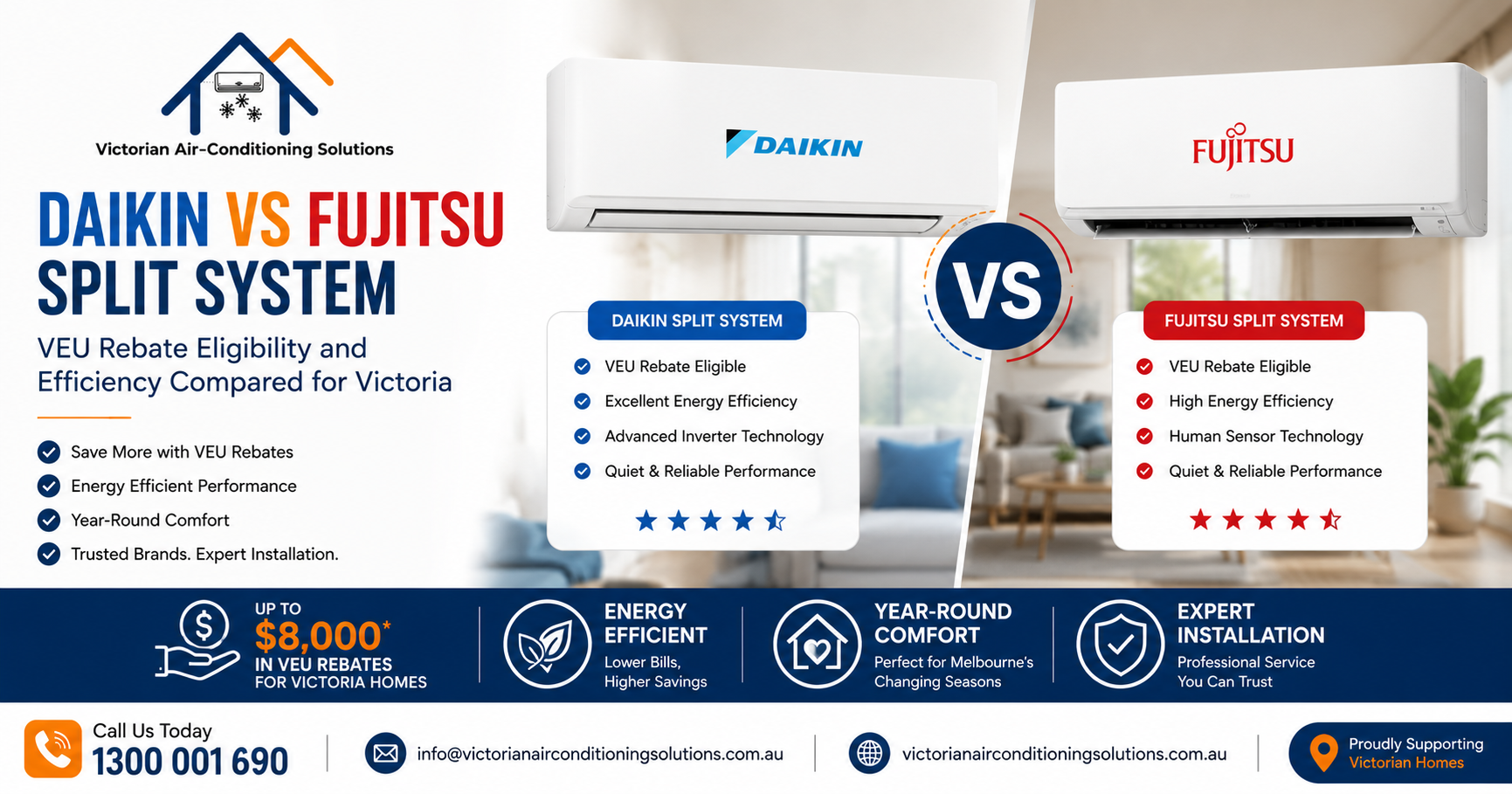
Daikin and Fujitsu are two of the most commonly installed air conditioning brands through VEU-accredited providers in Victoria. Both companies are Japanese, both have broad product ranges approved under the Victorian Energy Upgrades (VEU) program, and both are trusted names in Australian homes — yet they have meaningfully different strengths that can influence both your upfront rebate and your long-term running costs.
Victorian Air Conditioning Solutions installs both brands across Melbourne and regional Victoria. Here is our comprehensive, fact-based comparison.
Brand Backgrounds
Daikin
Daikin is the world’s largest air conditioning manufacturer, founded in Japan in 1924. Their Australian operation is one of their most significant markets globally, and they maintain a dedicated network of authorised and accredited installers across Victoria. Daikin is singular among major AC brands in that air conditioning is their only product category — their entire R&D focus is on HVAC technology.
Fujitsu General
Fujitsu General — a separate listed company from Fujitsu Limited, the IT conglomerate — has been manufacturing air conditioning systems since 1936. In Australia, the Fujitsu brand has built a reputation for reliability, comprehensive warranty coverage, and exceptional service network coverage. Consumer satisfaction surveys consistently place Fujitsu among the top-performing brands in Australia for long-term reliability.
Energy Efficiency & VEU Eligibility
VEU rebate values are determined by the number of Victorian Energy Efficiency Certificates (VEECs) generated by an installation. This in turn depends on the system’s energy efficiency rating — higher star ratings and higher COP/EER values generate more VEECs and therefore a larger rebate.
| Specification | Daikin (Perfera / Alira X) | Fujitsu (ASTG / AOTG Series) |
| Seasonal COP (Heating) | Up to 5.1 (Perfera) | 4.2 – 4.8 |
| SEER (Cooling) | Up to 9.0 (Perfera) | 6.0 – 7.5 |
| Energy Star Rating | Up to 7 stars | Up to 5.5 stars |
| R32 Refrigerant | Yes — standard across range | Yes — standard across range |
| VEU Product Register | Multiple eligible models | Multiple eligible models |
| Min. Operating Temp (Heating) | -20°C outdoor | -15°C outdoor (standard models) |
For maximum VEU rebate value: Daikin’s Perfera series, with its higher SCOP and star rating, will generally generate more VEECs — and therefore a higher rebate — than an equivalent-capacity Fujitsu model.
Reliability Data
Long-term reliability is a critical consideration for an appliance expected to last 10–15 years. Based on consumer reliability surveys and HVAC technician data covering Australian-market units installed between 2021 and 2025, Daikin and Fujitsu both perform near the top of the reliability rankings:
- Daikin: approximately 5.7% failure rate in the first five years
- Fujitsu: approximately 6.5% failure rate in the first five years
- Both significantly outperform lower-tier brands (Midea 18.2%, Carrier 14%)
Fujitsu’s service network is one of the most comprehensive in Australia, with an extensive number of authorised service agents. This means faster repair turnaround in regional Victorian areas like Ballarat, Bendigo, and the Mornington Peninsula.
Air Quality Features
Daikin Flash Streamer
Daikin’s Flash Streamer technology actively decomposes airborne contaminants including allergens, bacteria, mould, and viruses using high-speed electron discharge. Daikin is the only split system brand approved by the National Asthma Council Australia’s Sensitive Choice programme — a meaningful distinction for allergy and asthma households.
Fujitsu Bio-Air Filter
Fujitsu’s systems include a Bio-Air filter that captures dust, pollen, and fine particles. Some models also feature a catechin filter that inhibits bacteria. While effective, Fujitsu’s air purification approach is passive filtration rather than the active ionisation used in Daikin’s Streamer system.
Multi-Head & Commercial Range
One area where Fujitsu has a clear advantage is the breadth of their multi-head split system range. Fujitsu’s ASTG Multi-Split range covers configurations from 2 to 5 indoor heads connected to a single outdoor unit, with a wider variety of indoor unit styles including floor-console, cassette, and high-wall variants. This makes Fujitsu particularly strong for multi-room residential applications and light commercial settings.
Daikin’s Multi system range is also comprehensive, but Fujitsu’s long history in this segment gives them a slight edge in configuration flexibility and installer familiarity.
Pricing & Warranty Comparison
| Factor | Daikin | Fujitsu |
| Typical 7.1 kW Supply Price | $1,600 – $2,000 | $1,400 – $1,800 |
| Standard Warranty | 5 years (parts & labour) | 5 years (parts & labour) |
| Extended Warranty | 7 years on select models (online registration) | Not typically offered |
| Cashback Promotions | Occasional seasonal offers | Frequent cashback offers — check current promotions |
| Australian Service Network | Strong metro coverage | One of the most comprehensive nationally |
Conclusion
Daikin edges ahead on peak energy efficiency and air purification technology, which can translate to a higher VEU rebate and lower running costs over the system’s life. Fujitsu is an excellent choice for value-conscious buyers, multi-room installations, and households in regional Victoria who benefit from Fujitsu’s extensive service network. Both brands are strong, reliable, and fully VEU-eligible — the right choice depends on your specific capacity requirement, room configuration, and budget.
Ready to upgrade? Contact Victorian Air Conditioning Solutions today:
Email: info@victorianairconditioningsolutions.com.au | Call: 1300 001 690
Free on-site assessment • VEU rebates applied upfront • Licensed & accredited installers

Leave a Reply