
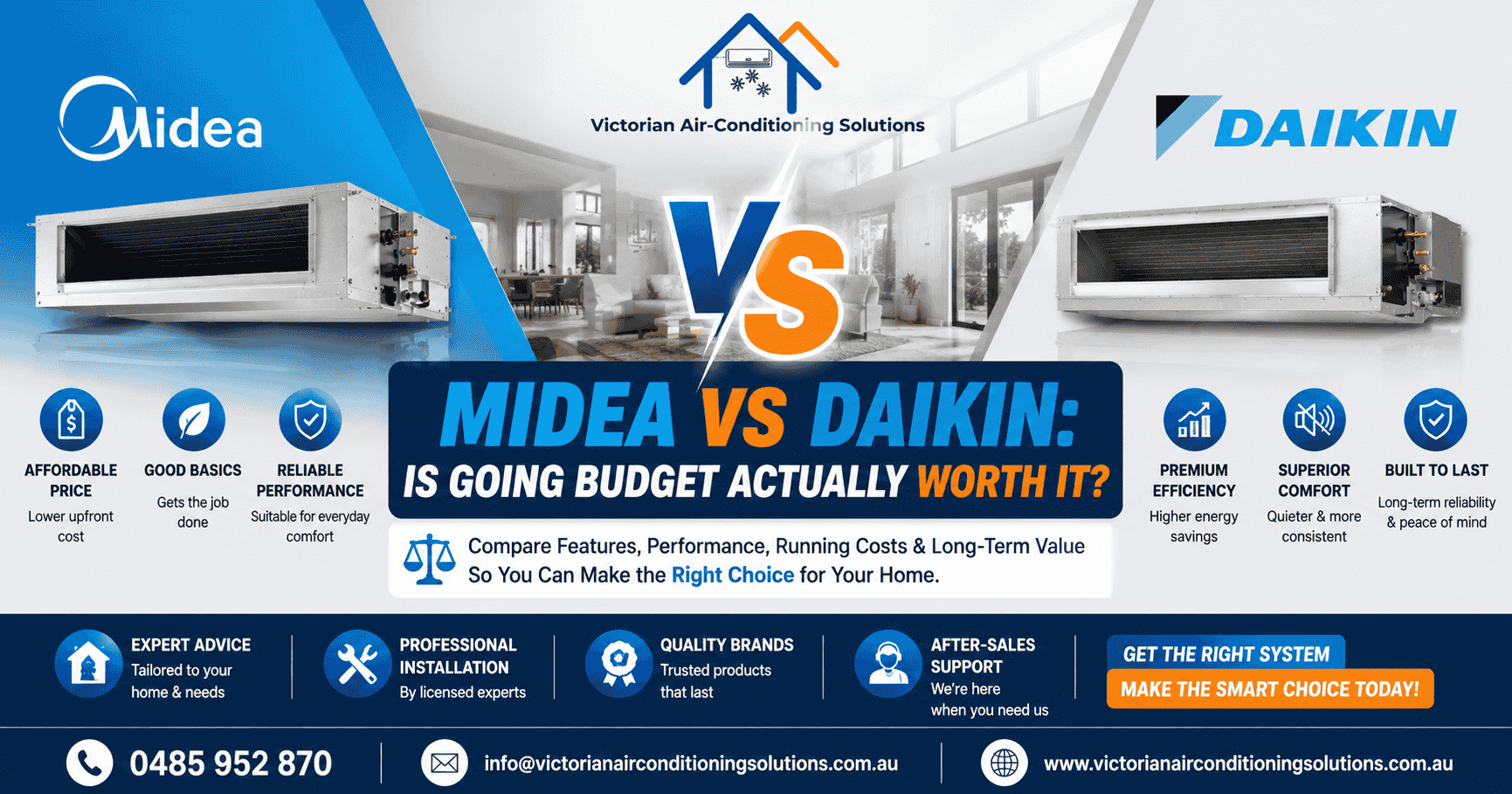
If you’ve spent any time researching air conditioners for your home, you’ve probably landed on this exact question. Midea keeps popping up because it’s cheap. Daikin keeps popping up because everyone says it’s the gold standard. And somewhere in between, you’re left wondering whether the extra money for Daikin actually buys you anything — or whether you’re just paying for a name.
We get asked this almost every week at Victorian Air Conditioning Solutions, so let’s actually pull it apart properly instead of giving you a vague “it depends.”
Two very different stories
Midea is a Chinese manufacturer that’s been making appliances since 1968. It’s massive globally, and in Australia it’s carved out a strong niche by being the system installers reach for when a job needs to come in under budget — rental properties, smaller apartments, or homeowners who just want gas heating gone without spending a fortune to do it.
Daikin tells a different story. It’s the brand HVAC technicians themselves tend to install in their own homes, and it’s earned that reputation over decades through consistent build quality and an Australian dealer network that’s been around long enough to actually back up its warranty claims.
Neither of these reputations came from marketing. They came from what happens five, eight, ten years after installation — which is really the only timeframe that matters when you’re comparing them.
Price: the obvious part
There’s no getting around it — Midea is cheaper to buy and install. That’s the entire appeal, and it’s a legitimate one if you’re working with a tight budget, fitting out an investment property, or you know you won’t be in the home long-term.
Daikin costs more upfront. Sometimes noticeably more, depending on the capacity and series you’re after. The question isn’t whether Daikin costs more — it does — it’s whether that gap closes over time.
Running costs: where it gets interesting
This is the bit a lot of budget comparisons skip over. Victoria has some of the highest electricity prices in the country, so the efficiency of the system you choose actually shows up on your bill every single quarter, not just on the spec sheet.
Daikin’s inverter technology tends to deliver better real-world efficiency, particularly in the kind of heat and cold extremes Victoria throws around. Midea systems are competitive on paper, especially in the higher-tier Athena and EOS ranges, but the day-to-day energy use is generally a touch higher than what you’d get from Daikin doing the same job.
So if you’re keeping the system for a decade, some of that upfront saving on Midea quietly gets eaten back by higher running costs. If you’re only keeping it for a few years, that math barely matters.
Warranty: read the fine print, not the headline number
Midea is sometimes marketed with longer warranty periods depending on the series, which sounds great until you look at how the claims process plays out in practice. Customer experiences with Midea’s warranty support in Australia are mixed — some people get a smooth resolution, others report slower turnarounds and unexpected costs, often tied to installation quality.
Daikin’s warranty is more modest on paper — a 5-year parts and labour warranty on split, multi-split and ducted systems installed in Australian homes — but it’s backed by a dealer network that’s over 500 strong nationally, which tends to mean faster service when something does go wrong.
A long warranty you can’t easily use isn’t worth as much as a shorter one that’s straightforward to claim against.
Noise and reliability: the stuff you notice at 2am
If the unit’s anywhere near a bedroom, this matters more than people expect. Daikin has a strong reputation for whisper-quiet operation, which is exactly why it’s the brand most often recommended for bedrooms and living areas where you actually have to live with the hum.
Midea performs fine for general use, but it’s not typically the brand technicians reach for when ultra-quiet operation in a bedroom is the priority.
On reliability, the pattern across installer feedback and customer reviews is fairly consistent: Daikin systems tend to need fewer call-outs over their lifespan. Midea isn’t unreliable exactly — it’s more that it’s built to a price point, so it’s more likely to need attention sooner, particularly if installation wasn’t done properly. That last part is worth repeating: a lot of Midea’s worst reviews trace back to installation issues, not the unit itself. Brand only gets you halfway — the installer gets you the rest of the way.
What about rebates?
Good news here, and it applies regardless of which brand you choose: both Midea and Daikin systems are eligible under the Victorian Energy Upgrades (VEU) program. The rebate amount comes down to the capacity of the system and what you’re replacing — not the badge on the unit. So if you’re switching from gas heating to a reverse-cycle system, you can access the same rebate support whether you go Midea or Daikin.
This is genuinely useful information because it means the rebate isn’t a reason to pick one brand over the other — it just makes whichever one you land on more affordable.
So, is budget actually worth it?
Honestly — sometimes, yes.
Midea makes sense if you’re fitting out a rental, you’re on a tight renovation budget, you don’t plan on being in the property for the long haul, or you just need gas heating replaced without a big spend. It does the job, it’s eligible for the same rebates, and for shorter ownership windows the gap in running costs and longevity barely has time to matter.
Daikin makes more sense if you’re staying put for years, the unit’s going somewhere you’ll actually hear it (like a bedroom), or you’d rather pay once and not think about it again. The extra cost upfront tends to even out through lower running costs and fewer repairs over a 10+ year stretch.
There’s no universally “right” answer here — it genuinely depends on how long you’re keeping the system and what you’re using it for. What we’d say, though, is that whichever brand you land on, the quality of the installation will affect your experience more than the badge on the unit does.
Not sure which way to go?
That’s exactly what we’re here for. Tell us about your home, your budget, and how long you’re planning to stay, and we’ll give you a straight answer on which system actually makes sense for your situation — not just whichever one’s easiest to sell.
📞 0485 952 870 📧 info@victorianairconditioningsolutions.com.au
Pricing and rebate figures mentioned above are indicative and subject to change. Always confirm current VEU rebate eligibility and final pricing with our team before making a decision.

Leave a Reply