
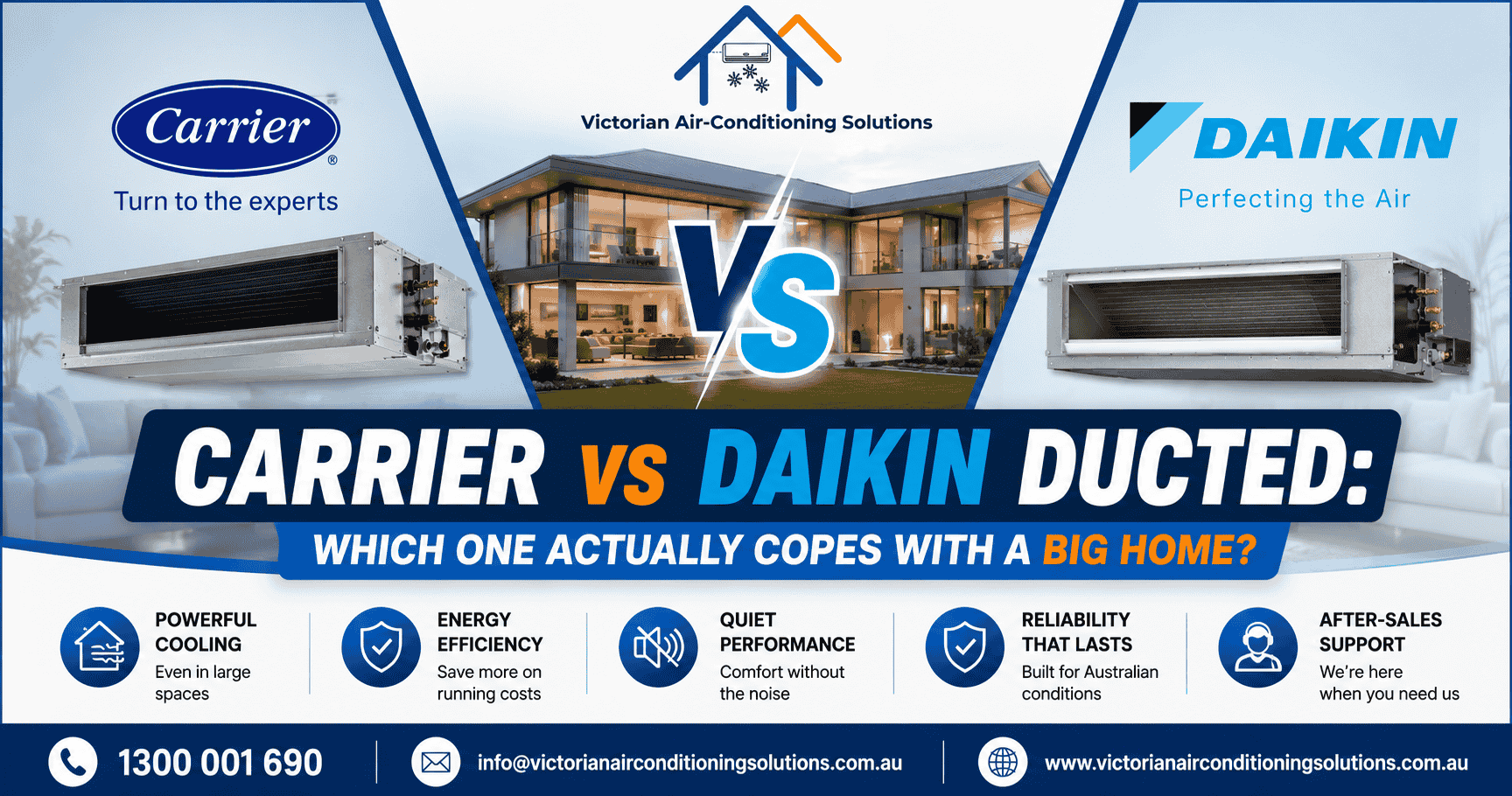
Carrier vs Daikin Ducted Air Conditioning Victoria
If you’ve started looking into ducted air conditioning for a large home, you’ve probably noticed two names keep coming up — Carrier and Daikin. Both are well-established, both make solid gear, and both will keep a home comfortable through a Victorian summer and a Victorian winter. So why does the choice still feel confusing?
Because for a big home, the question isn’t really “which brand is better” — it’s “which system handles the harder job better.” A 100m² unit and a 35-square home with two storeys, long duct runs and ten outlets are two completely different engineering problems. That’s where the real differences between these two brands start to show.
We install both brands across Melbourne and regional Victoria, so this isn’t a sales pitch for one over the other. It’s what we’ve learned from actually putting these systems into large homes, plus the manufacturer specifications behind them.
Why Large Homes Need a Different Conversation
A smaller home can usually get away with almost any decent ducted system. A larger home is less forgiving. Three things matter more as floor area grows:
- Capacity range — can the outdoor unit comfortably cover the whole house without being oversized and short-cycling?
- Static pressure — can the indoor unit push air through long duct runs to outlets at the far end of the house without losing performance?
- Zoning — can different parts of the home be heated or cooled independently, so you’re not paying to condition rooms nobody’s in?
Get any one of these wrong and you end up with a system that’s either struggling in the back bedrooms, costing far more to run than it should, or both.
Carrier: Built Around High Static Performance
Carrier’s residential ducted range in Australia — the QSH High Static series — is specifically engineered for homes where ductwork has to travel further and serve more outlets. That’s a meaningful detail for larger floor plans, because “high static” essentially means the indoor fan has more push behind it to overcome resistance in long or complex duct runs.
A few things stand out in Carrier’s specifications for the larger end of the range:
- The 16.2kW Carrier QSH unit has a cooling capacity range from roughly 3.5kW up to 20.8kW, and a heating range up to around 21kW, which gives it real flexibility to throttle down for mild days and ramp up for extreme heat or cold without cycling on and off constantly.
- It runs on R32 refrigerant, which is more efficient and has a lower environmental impact than older refrigerants.
- Rated efficiency sits around EER 3.29 for cooling and COP 3.91 for heating — solid numbers for a system built primarily for residential comfort rather than light commercial use.
- It comes with a wired controller with weekly scheduling, so you can program different routines for weekdays and weekends.
For a large home with a single level and long duct runs to bedrooms at the far end of the house, this is exactly the scenario the High Static range is designed to solve.
Daikin: Engineered for Flexibility Across Different Roof Spaces
Daikin’s approach to large homes is less about one flagship unit and more about having the right configuration for the building itself. Their Premium Inverter and Inverter Ducted ranges scale up to similar capacities — the 16kW Daikin system, for example, covers a cooling range from about 7.3kW to 17kW and heating from 7.3kW up to 20kW.
What tends to set Daikin apart in larger or more complex homes is the range of indoor unit formats available:
- Slim-line units for homes with limited ceiling cavity space.
- Bulkhead units where a fully concealed roof installation isn’t practical.
- Underfloor systems, useful in colder regional Victorian properties where heating performance matters more than cooling.
Daikin also uses Variable Refrigerant Temperature technology, which continuously fine-tunes compressor speed and refrigerant temperature rather than just switching between on and off states. In a large home with varying loads — a north-facing living area baking in the afternoon sun while bedrooms on the other side stay cool — this kind of fine control can mean steadier comfort room to room.
Daikin backs its split, multi-split and ducted systems with a 5-year parts and labour warranty across Australia, and their MyAir-style controllers support zoning down to individual rooms, with smartphone app control and voice assistant integration through Google Assistant or Amazon Alexa.
Side-by-Side: The Numbers That Matter for a Big House
| Carrier QSH (16.2kW model) | Daikin Premium Inverter (16kW model) | |
|---|---|---|
| Cooling capacity range | 3.5kW – 20.8kW | 7.3kW – 17.0kW |
| Heating capacity range | ~2.9kW – 21.1kW | 7.3kW – 20.0kW |
| Refrigerant | R32 | R32 |
| Rated cooling efficiency | EER 3.29 | EER ~3.30 |
| Rated heating efficiency | COP 3.91 | COP ~3.87 |
| Best suited to | Long duct runs, multiple outlets, high static resistance | Homes needing flexible indoor unit placement (slim-line, bulkhead, underfloor) |
| Warranty | Manufacturer warranty (check current terms at installation) | 5-year parts and labour |
| Controller | Wired controller with weekly timer | Touchscreen wall controller, app and zoning options |
Specifications are indicative and based on manufacturer data current at the time of writing. Exact figures vary by model, phase and indoor unit pairing — always confirm against the current spec sheet for your selected system.
Looking at these side by side, the two brands are closer in raw capability than most people expect. Carrier’s strength shows up in homes where the ducting itself is the challenge — long runs, multiple branches, harder-to-reach zones. Daikin’s strength shows up in homes where the physical installation is the challenge — tight ceiling cavities, split-level designs, or a need for very granular room-by-room control.
What This Means for Victorian Homes Specifically
Victoria isn’t a one-season state. A system installed in Bendigo or Ballarat needs to handle frosty mornings and dry, hot summer days. A system in coastal or bayside Melbourne deals with more humidity. Both Carrier and Daikin units are rated to operate across this kind of range, with outdoor units designed to keep working efficiently from sub-zero mornings through to 40-plus degree heatwave days.
If you’re replacing old gas ducted heating with a reverse-cycle electric system, that switch can also make you eligible for incentives under the Victorian Energy Upgrades (VEU) program, depending on your current system and the new unit’s efficiency rating. Eligibility and rebate amounts vary by property and system, so it’s worth getting a site assessment to confirm what applies to your home rather than assuming a flat figure.
So Which One Should You Choose?
Honestly — for most large Victorian homes, either brand will do the job well when it’s sized and installed correctly. The bigger risk isn’t picking the “wrong” brand, it’s getting the sizing, zoning or duct design wrong for your specific floor plan. We’ve seen plenty of homes where a perfectly good unit underperforms simply because it was specified for the wrong layout.
That’s really the conversation worth having before you commit to either system: how many zones does your home actually need, where are the heat-load problem areas, and what does your roof space allow for in terms of indoor unit placement.
Get the Right System for Your Home, Not Just a Brand Name
We install and service both Carrier and Daikin ducted systems across Melbourne and regional Victoria, and we’ll size the system around your actual home — not the other way around. If you’re planning a ducted upgrade for a larger property, we’re happy to walk through what suits your layout, your budget and your household.
Call Victorian Air Conditioning Solutions on 0485 952 870 or email info@victorianairconditioningsolutions.com.au for a free, no-obligation assessment.
All pricing and rebate information referenced in this article is indicative only and subject to change. Speak with our team to confirm current terms and conditions for your property.

Leave a Reply